
Saint Mary’s Laboratory Launches New In-House PCR Testing for Tick Borne Diseases
April 6, 2026Categories: Events
With spring in full bloom, tick activity is rising across New England, especially here in Connecticut, where blacklegged ticks (also known as deer ticks or Ixodes scapularis) are still being found in high numbers statewide. Recent statewide surveillance by the Connecticut Agricultural Experiment Station (CAES) collected more than 10,000 ticks across all eight counties in 2025, confirming that blacklegged ticks remain consistently abundant and continue to carry pathogens including Anaplasma phagocytophilum and Babesia microti.
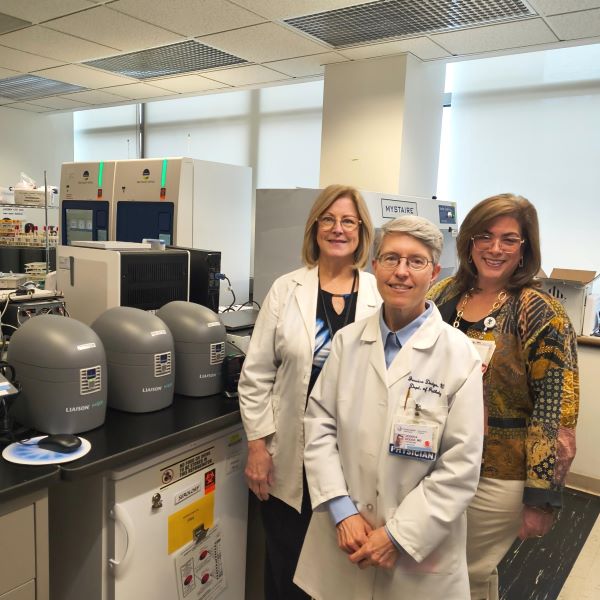
(L to R): Lisa Vaccarelli, BS, SM(ASCP)MT, SM(AAM), Microbiology Team Lead; Jessica Dodge, MD, Pathologist and Medical Director; and Margaret Jenkins, BS MT H(ASCP)cm, Laboratory Manager.
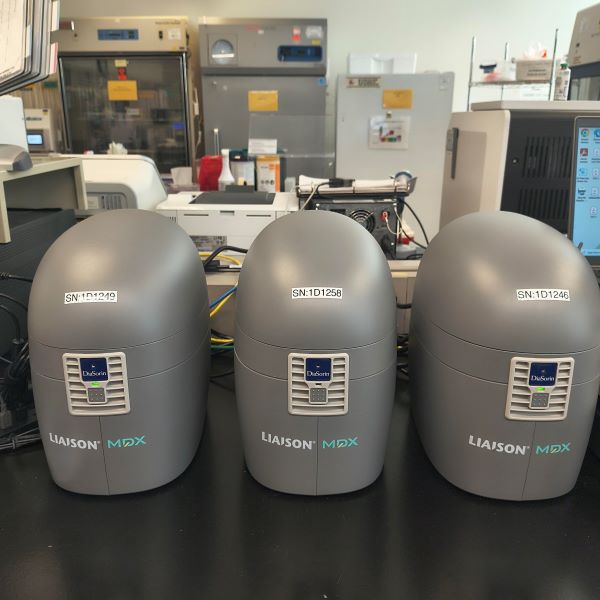
DiaSorin Liaison MDX machines in the Saint Mary's Hospital Laboratory.
In response to this heightened seasonal risk, Saint Mary’s Hospital Laboratory launched in-house PCR testing for two major tick borne organisms:
• Anaplasma phagocytophilum – a bacterium spread by blacklegged ticks
• Babesia species – protozoan parasites spread by blacklegged ticks or by transfusion of contaminated blood
Testing is performed through a blood test on the DiaSorin Liaison MDX. It is a real time PCR thermocycler that delivers rapid, accurate results within 24 hours.
Three new in-house test options are now available:
• Anaplasma phagocytophilum and Babesia spp. Molecular Study
• Anaplasma phagocytophilum Qualitative Real Time PCR
• Babesia Species Molecular Study
“Having this testing in-house will allow prompt diagnosis of anaplasmosis and babesiosis. Instead of waiting days for results to return from an out of state reference laboratory, most results will be ready within 24 hours. This is particularly important for patients with babesiosis, because the treatment differs from Lyme disease, anaplasmosis, and ehrlichiosis,” said Jessica Dodge, MD, Pathologist and Medical Director of the Saint Mary’s Microbiology Laboratory.
As Connecticut continues to report elevated levels of tick borne pathogens in blacklegged ticks, faster diagnostic opportunities, such as PCR testing, play a crucial role in timely patient care. Ticks can be hard to spot. The Uncas Health District recommends using a mirror when doing tick checks. After spending time outdoors, it is recommended that you check your entire body, specifically:
• under the arms
• behind the knees
• in and around the ears
• in the hair and along the scalp
• inside the belly button
• around the waist
• between the legs and in the groin area
For more information on tick safety, visit our website here: Ticks 101 | Trinity Health Of New England