
Saint Mary’s Hospital Surpasses 50 Obstructive Sleep Apnea Procedures
July 13, 2026Categories: Organizational Updates
Saint Mary’s Hospital Operating Room achieved an important milestone on June 26 by completing the 50th and 51st obstructive sleep apnea implantation device procedures. For the clinical staff, this was more than just a number, it marked a new chapter in treating obstructive sleep apnea (OSA) for people in the Greater Waterbury area.
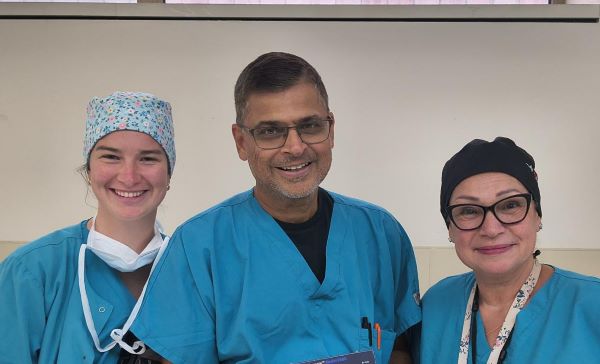
Saint Mary's Hospital Operating Room team celebrate 50th and 51st Obstructive Sleep Apnea therapy procedure.
Since launching the program alongside Saint Francis Hospital in 2024, Saint Mary’s became the first in greater Waterbury to offer this sleep apnea treatment to OSA patients. In just two years, what began as an innovative option became a transformative standard for many patients who once had limited options.
OSA is more than just “restless nights.” It affects a person’s quality of life. During sleep, relaxed airway muscles can let the tongue fall back and block airflow, creating a tiring cycle. This lowers oxygen levels and makes the brain wake up, so restful sleep is interrupted again.
For years, continuous positive airway pressure (CPAP) machines have been the main treatment. However, many people find the masks and hoses uncomfortable, making it hard to stick with the therapy.
The unique OSA treatment works inside the body. A small implant sends gentle pulses to the airway muscles, moving the tongue slightly with each breath to keep the airway open. Patients can control the system with a handheld remote and an app, giving them more control over their treatment.
“It’s not just about the technology,” said Ear, Nose and Throat (ENT) partner Mahesh Bhaya, MD. “It’s about restoring quality of life. We’re giving patients the ability to sleep deeply again, to wake up energized and to feel like themselves. That’s incredibly meaningful for our team and our community.”
Last year, the FDA expanded the eligibility rules, raising the apnea-hypopnea index (AHI) limit from 65 to 100 events per hour and increasing the body mass index (BMI) limit from 32 to 40. Now, more patients who were previously ineligible can benefit.
Completing more than 50 procedures is not just a milestone, it shows the teamwork, care and skill of everyone involved. Surgeons, anesthesiologists, nurses and support staff have all worked together to make this innovation possible for each patient.
For more information on the Obstructive Sleep Apnea therapy available at Saint Mary’s Hospital and Saint Francis Hospital, here.